Verify InsuranceGet Directions
Get Help Now (732) 333-3167
Discovery Institute
  • Detox
    • Alcohol Detox
    • Amphetamine Detox
    • Benzodiazepine Detox
    • Cocaine Detox
    • Drug Detox
    • Medical Detox
    • Opiate Detox
    • Prescription Drug Detox
    • Meth Detox
    • Fentanyl Detox
    • Heroin Detox
  • Residential Treatment
    • Rehab
    • Treatment for Young Adults
    • Treatment for Adults
    • Treatment for Seniors
  • Programs
    • Intensive Outpatient Program
    • Addiction Counseling
      • Individual Therapy
      • Group Therapy
      • Cognitive Behavioral Therapy
      • Dialectical Behavior Therapy
      • Equine Therapy
      • Family Therapy
    • Dual Diagnosis
      • ADHD and Addiction
      • Anxiety and Addiction
      • Bipolar Disorder and Addiction
      • Depression and Addiction
      • Eating Disorders and Addiction
      • OCD and Addiction
      • PTSD and addiction
      • Personality Disorders and Addiction
    • Holistic Addiction Treatment
    • Relapse Prevention
    • Telehealth Treatments
    • Treatment Planning
    • Vocational Services
    • Alumni Program
  • Resources
    • Blog
    • Family Support
    • Addiction Guides
      • Am I an Addict?
      • Addiction & Health Problems
      • The Stages of Addiction
      • Guide for Parents of Addicts
      • Guide for Spouses of Addicts
      • Guide for the Children of Addicts
      • Understanding Overdose
      • Going Through Withdrawal
    • Insurance Coverage
      • Verify Your Insurance
      • Aetna Insurance
      • Blue Cross Blue Shield
      • Emblemhealth Insurance
      • Prosper
      • Tricare Insurance
      • Humana Insurance
      • Oxford Healthcare
      • United Healthcare
      • MHC for Treatment
      • 1199 Insurance
      • Princeton Health/MedPro Health Insurance
      • Horizon NJ Insurance
      • New York Hotel Trade Insurance
      • NY State Empire Plan Insurance
      • Empire Bluecross Blueshield
      • Iron Workers Local #40 Insurance
      • Qualcare
      • Beacon Health Options
      • Magnacare
      • Magellan
      • Amerihealth
      • Anthem Bluecross Blueshield
    • Interventions
    • Overdose Response Initiative
      • Naloxone Finder
      • Distribution
      • Overdose Resources
    • Sober Living
    • FAQ’s
    • Helpful Links
  • About
    • Our Purpose
    • Our Team
    • Our Facility
    • Our Technology
    • Our Research
    • Our Editorial Policy
  • Contact
    • Admissions
    • Directions
    • Referral
    • Careers
Treatment
Home / Blog / Is Baclofen Addictive? What Is It Used For?

Is Baclofen Addictive? What Is It Used For?

Written by

Dr. Michael DeShields

Posted On: August 13, 2020
Is Baclofen Addictive? What Is It Used For?

Jump to Section

Toggle
    • Table of Contents
  • What is Baclofen?
  • Baclofen Side Effects
  • Using Baclofen to Treat Addiction
    • Call Discovery today to schedule a free evaluation
  • Baclofen Dosage
  • Risks of Taking Baclofen
  • Baclofen Misuse
  • Mixing Baclofen With Other Medications and Substances
  • Mixing Baclofen With Alcohol
  • Symptoms of Baclofen Overdose
  • Is Baclofen Addictive?
  • Baclofen Withdrawal
  • Baclofen Addiction Treatment
  • Discovery Institute Is Here to Help You

Table of Contents

  • What is Baclofen?
  • Baclofen Side Effects
  • Using Baclofen to Treat Addiction
  • Baclofen Dosage
  • Risks of Taking Baclofen
  • Baclofen Misuse
  • Mixing Baclofen With Other Medications and Substances
  • Mixing Baclofen With Alcohol
  • Symptoms of Baclofen Overdose
  • Is Baclofen Addictive?
  • Baclofen Withdrawal
  • Baclofen Addiction Treatment
  • Discovery Institute Is Here to Help You

Disclaimer: The content in this blog is intended for informational purposes only and should not be considered a substitute for medical advice from a healthcare provider. It is not meant for the diagnosis or treatment of any illness or medical condition. In non-emergency situations, Discovery Institute is available to guide recovery, well-being, and assistance.

What is Baclofen?

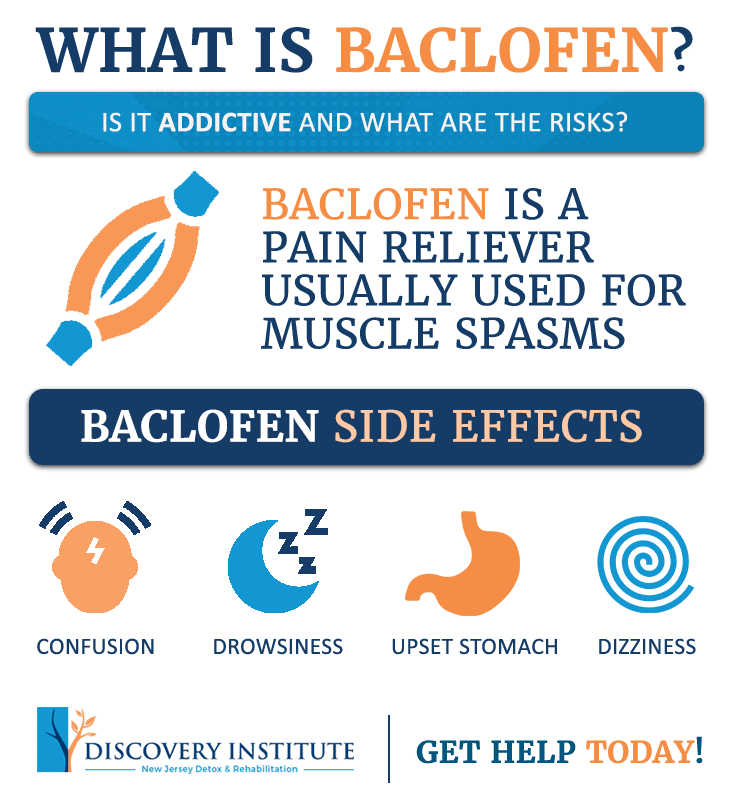
Baclofen is a prescribed medication for people who need pain relief from muscle spasms. Although it is still not exactly known how baclofen is believed to be able to treat painful muscle spasms by interacting with your central nervous system’s GABA receptors and blocking the signals that your nervous system sends out to your muscles to spasm. Baclofen can also improve muscle movement.

Because of the relaxing effects that baclofen has on muscles, baclofen is considered a muscle relaxer. If you need it to be, you can also use baclofen as one of a combination of medications for combination therapy. People with conditions such as multiple sclerosis and spinal injury and disease are primary candidates for the use of baclofen.

Baclofen can come in the form of an oral tablet, oral solution, oral powder for suspension, or spinal injection. The peak concentration of baclofen in the bloodstream occurs 1-3 hours after taking the medication orally. The half-life of baclofen is 3-4 hours in the plasma, and the total shelf life of baclofen after its date of manufacture is 3 years. Only a healthcare provider can give you the spinal injection form of baclofen.

Baclofen is a generic medication. Some brand name versions of baclofen include Gablofen, Lioresal, and Kemstro. Lioresal is the most well-known brand name version of baclofen.

Many people wonder if baclofen is addictive and if is there such a thing as a baclofen withdrawal. To find out the answer to this question, you must first learn about the different ways that people use and misuse baclofen and the effects that such use and misuse causes.

Baclofen Side Effects

  • Drowsiness
  • Dizziness
  • Muscle weakness
  • Confusion
  • Upset stomach

More dangerous and severe side effects of baclofen include seizures and difficulty breathing.

Using Baclofen to Treat Addiction

Baclofen was created to treat epilepsy but was only minimally successful. It was not until 2009 when a cardiologist named Olivier Amiesen published a memoir that talked about how he was able to recover from alcoholism by taking baclofen that researchers started to look into the ways that baclofen could help treat addiction.

There have been many reports and claims of baclofen helping with addiction treatment since that time. Although baclofen use for addiction treatment has become prominent in the medical field, because there is still not enough research to prove that baclofen can help treat addiction, it is still considered an off-label addiction treatment medication.

Baclofen is used as an off-label addiction treatment medication because its chemical makeup mimics gamma-aminobutyric acid (GABA), a bodily chemical that calms your mood. As a result, baclofen has a calming effect that causes dopamine levels to increase in the body.

By increasing the body’s dopamine levels, baclofen helps people feel better when dealing with cravings. The feel-good effects of baclofen can lessen cravings for other substances altogether. As a result, baclofen helps people suffering from addiction manage their withdrawal symptoms.

Baclofen is great for helping people manage their withdrawals and dependence on substances such as alcohol, opioids, cocaine, and tobacco. Clinical research trials have particularly shown promise in baclofen treating opioid addiction.

Call Discovery today to schedule a free evaluation

Our compassionate counselors are standing by to answer any questions you may have. During the confidential evaluation, Discovery’s clinicians will determine the appropriate level of care for you.

Get Help Now (844) 478-6563

Baclofen Dosage

According to the Electronic Medicines Compendium, you should increase and decrease your dosage of baclofen gradually over time. The action of gradually increasing and decreasing your dosage of medications is called tapering. Not tapering your baclofen dosage could lead to severe side effects.

The recommended maximum daily dose of baclofen is 100 mg. Most baclofen prescriptions are in small and frequent doses. You’re supposed to take oral forms of baclofen around 3 times a day. When you start taking baclofen, you should do so in small doses at first and then gradually increase to larger doses. When you are stopping taking baclofen, do so in small increments over a period of 1-2 weeks.

If you suddenly stop taking baclofen, your muscle spasms may get worse. If you miss your doses or do not take your baclofen as scheduled, it may not work as well as it should. This is because a certain amount of baclofen must be in your body at all times for baclofen to work properly. Taking too much baclofen could cause severe side effects or an overdose.

baclofen_infographic_discovery

Risks of Taking Baclofen

Taking baclofen can cause severe allergic reactions. For example, if allergic to baclofen, you could develop trouble breathing and/or swelling of your throat or tongue. Taking baclofen again after a severe allergic reaction could lead to death. Therefore, healthcare professionals suggest not taking baclofen if you’ve ever had an allergic reaction to it.

If you have epilepsy, baclofen could make your seizures worse. Therefore, make sure to talk to your doctor about whether or not baclofen is safe for you to use.

People with kidney problems or kidney disease may have issues clearing baclofen from their bodies. As a result, the levels of baclofen in your body when taking it could reach higher than normal levels and cause side effects. To counterbalance this, your doctor may prescribe you a lower than normal dosage of baclofen to start.

People with a history of strokes could develop more side effects to baclofen than the average person. Baclofen may not even be able to treat your muscle spasms if you have a history with strokes.

Other people that could develop more side effects to baclofen include the elderly, and people with impaired renal function. If you have galactose intolerance, active peptic ulceration, or porphyria, do not take baclofen. If you have severe psychiatric disorders, seizure disorders, sphincter hypertonia, liver disease, or diabetes mellitus, take baclofen with extreme caution. Baclofen may also not be right for you if you are already receiving antihypertensive therapy.

Ask your doctor if baclofen is safe for you to use while pregnant or breastfeeding. Children under the age of 12 should not take baclofen.

Baclofen Misuse

Because of the calming effect and the feel-good increase in dopamine levels that baclofen has on the body, many people start misusing baclofen. One way that people misuse baclofen is by taking more than what is prescribed to them.

Another way people misuse baclofen is by mixing it with other substances to increase their feel-good effects. If you misuse baclofen while also taking alcohol, tranquilizers, sleeping pills, or other muscle relaxants, it can cause you to experience weakness, dizziness, drowsiness, and imbalance.

Mixing Baclofen With Other Medications and Substances

Oftentimes, people will combine baclofen with central nervous system depressants to increase its effects. Other substances that people often mix baclofen with to receive a high are opioids, alcohol, and amphetamines.

Mixing baclofen with other substances is dangerous because it can lead to severe side effects. It is also dangerous because it could cause baclofen to interact with other substances.

When a medication interacts with another medication or substance, it alters the effects that that medication or substance has on your body. Some substances and medications that baclofen interacts with include alcohol, anesthetics, tricyclics, antidepressants, antihypertensives, dopaminergic, lithium, memantine, and NSAIDs.

If you are taking other medications for health reasons, make sure to tell your doctor before you also start taking baclofen. Taking baclofen with other central nervous system depressants could lead to severe levels of drowsiness. Therefore, you should not operate a vehicle or any other form of heavy machinery while taking this combination of medications.

Examples of other central nervous depressants include benzodiazepines, like triazolam and midazolam, and narcotics, like oxycodone and codeine.

Mixing Baclofen With Alcohol

Because baclofen and alcohol are both central nervous system depressants, mixing them heightens both of their effects to dangerous levels. People who take baclofen may mix it with alcohol to heighten their euphoric and calming effects. This is not wise as the extreme levels of drowsiness, weakness, dizziness, changes in mood, and agitation that mixing baclofen and alcohol will give you is dangerous.

Mixing alcohol and baclofen can even increase your blood pressure and heart rate and cause you to have seizures. Drinking alcohol while taking baclofen can also cause you to unknowingly overdose on baclofen.

Symptoms of Baclofen Overdose

  • Nausea
  • Vomiting
  • Severe muscle weakness
  • Problems breathing
  • Seizures
  • Coma
  • Slowed breathing or respiratory arrest
  • Heart issues
  • Slowed heart rate
  • Vertigo
  • Low body temperature
  • Lightheadedness
  • Loss of consciousness
  • Trouble breathing

Is Baclofen Addictive?

With the euphoric effects that it can cause and the high levels of misuse that it has, of course, it is. If you cannot stop taking baclofen without experiencing withdrawals, then it means that you have developed a dependence on it.

If your dependence gets so bad that your behavior changes and you will do almost anything to obtain more baclofen, you are suffering from a baclofen addiction.

Baclofen Withdrawal

Chronic misuse of baclofen can lead to dependence and addiction. Once you develop dependence or addiction to baclofen and you try to stop taking the medication, baclofen withdrawal symptoms arise. This is especially true if you stop using baclofen cold turkey.

Baclofen withdrawal symptoms include:

  • Visual. tactile, and auditory hallucinations
  • Confusion. Delirium, and Delusion
  • Insomnia
  • Dizziness
  • Nausea
  • Memory problems
  • Anxiety
  • Changes in perception
  • Hyperthermia
  • Depersonalization
  • Psychosis
  • Mania
  • Changes in behavior and mood
  • Tachycardia
  • Seizures
  • Tremors
  • Fever
  • Extreme rebound muscle rigidity and spasticity

Baclofen Addiction Treatment

If you are suffering from a baclofen addiction treatment, know that hope is not lost. Baclofen addiction treatment usually consists of detox, some form of inpatient or outpatient treatment, support groups, and aftercare. Because the sudden stop of baclofen can lead to dangerous effects, it’s important to slowly wean yourself off of the medication during detox.

Baclofen detox is essential when receiving addiction treatment for baclofen because of the severity of baclofen withdrawal symptoms. If necessary, you can receive medical interventions or co-occurring treatment during baclofen detox.

Because you will go through an intense detox during your baclofen addiction treatment, it is wise to attend an inpatient or residential treatment program afterward. That way you can receive the 24/7 care that you’ll need to remain sober after treatment is done.

Discovery Institute Is Here to Help You

At Discovery Institute, we offer numerous detox programs. If you are suffering from a baclofen addiction, you should consider entering our prescription drug detox program.

After detox, you can then attend our very effective residential or intensive outpatient treatment program. If you are suffering from a mental illness on top of your addiction, we also offer dual diagnosis treatment. We even provide numerous different forms of individual therapy and group therapy.

Whether you are looking to receive addiction treatment for baclofen or some other substance or mental health issue, Discovery Institute is here to help. To learn more about the addiction treatment services that we provide, contact us today.

Dr. Michael DeShields

Clinical Advisor

Read More

Need Professional Help With Addiction?

  • New Jersey Addiction Treatment
  • Addiction & Mental Health Programs
  • Intensive Outpatient Program (IOP) in New Jersey
  • Dual Diagnosis Treatment in New Jersey
  • Drug & Alcohol Detox Programs

Addiction Recovery & Detox

  • Depressant Drugs: Long-Term Side Effects
  • Involuntary Commitment Laws in New Jersey
  • Sleeping Pill Addiction
  • How to Find an AA Sponsor
  • 10 Common Questions About Alcohol Detox
  • Foods That Fight Depression
  • How Substance Abuse Affects Marriage

Drug & Substance Abuse FAQs

  • What Do Shrooms feel Like?
  • How Does Drinking Affect the Thyroid?
  • Can Adderall Cause a Heart Attack?
  • Can You Overdose on Cough Drops?
  • Does Alcohol Cause Mood Swings?
  • Are You Dealing With Dry Drunk Syndrome?
  • How Does Alcohol Affect Cortisol?
  • Do Illegal Drugs Cause Hair Loss?
  • What Drugs Cause Dilated Pupils?
  • Can Alcohol Abuse Cause Multiple Sclerosis?

Are You Covered For Insurance Treatment?

Insurance Logo
Insurance Logo
Insurance Logo
Insurance Logo
Insurance Logo
Insurance Logo
Learn More

Our Editorial Policy

The Discovery Institute aims to provide accurate, ethical, clinically sound information regarding addiction and mental health for individuals and their families. All content published by The Discovery Institute is reviewed for accuracy and clarity by qualified individuals and is medically reviewed. We aim to make complicated subjects easy to understand without resorting to fear-based marketing techniques or misleading assurances. Content is regularly reviewed and updated to reflect current best practices, ensuring readers receive reliable, supportive guidance.

Read More About Our Process

Copyright © 2026 Discovery Institute. All Rights Reserved.

Accessibility Toolbar

  • Powered with favoriteLove by Codenroll

GET IN TOUCH

We’re Ready When You Are.

Call 24/7 to have a discussion with one of our treatment professionals the call is completely free. Admission Line and explanation of convenient private phone and free prescreening.

Need Help? Contact Us

(732) 333-3167


Schedule Your Admission

Free assessment and 100% confidential  
  • This field is for validation purposes and should be left unchanged.
Footer Logo
  (732) 333-3167
  80 Conover Rd
Marlboro, NJ 07746
       
Joint-Commission

About Discovery

  • About
  • Meet Our Staff
  • Admissions Information
  • Contact Us
  • Get Directions
  • Review Us
  • Find Us On the Web
  • COVID-19 Protocols

Rehab & Treatment

  • Rehab Programs
  • Drug Rehab
  • Alcohol Detox
  • Drug Detox

Get Directions

Map

Addiction Resources

  • Learn About Addiction
  • Am I An Addict
  • Common Rehab Questions
  • Insurance Verification

Copyright © 2025. All Rights Reserved. Discovery Institute Recovery Center | Privacy Policy | Accessibility

Jump to Section

×
    • Table of Contents
  • What is Baclofen?
  • Baclofen Side Effects
  • Using Baclofen to Treat Addiction
    • Call Discovery today to schedule a free evaluation
  • Baclofen Dosage
  • Risks of Taking Baclofen
  • Baclofen Misuse
  • Mixing Baclofen With Other Medications and Substances
  • Mixing Baclofen With Alcohol
  • Symptoms of Baclofen Overdose
  • Is Baclofen Addictive?
  • Baclofen Withdrawal
  • Baclofen Addiction Treatment
  • Discovery Institute Is Here to Help You
→ Table of Contents